Reading Drop #1 | Sweltering Summers and Wine-Dark Seas (Summer 2026)

I'm beginning to emerge, like a mole person, blinking into the sun, from a absolutely wild period of PhD deadlines, paper revisions and resubmissions, fellowship applications, model-building and other paper submissions, Confirmation of Status-writing and - oh my god - it has been intense! I guess you could say I've been 'locked in,' hence no blogging. Maybe I could start a YouTube vlog on 'How to lock-in like a tired working moms hobbling themselves towards a finish line looking haggard and relying on eye creams and the odd yoga class so as not to completely disassemble.' This is the type of content I consume when I'm simultaneously exhausted and hating myself and my writing (which is approximately every late-Thursday afternoon.) It reliably makes me feel better.
And yet, even when we're tired, we read. Because reading is the juice. Without it, I go as dry and prickly as the sunflowers I planted in May and then didn't have time to water. Mostly I try to come to writing a blog post with a fully formed thought, or at least a well-reasoned skreed. But in this instance, it's just fun to reflect on a summer's worth of survival-reading and idea-consuming and vibe-aquiring.
So here's everything I've read (including audiobooks, which count!) in the last few months and a few half-baked thoughts about them.

Overshoot (Andreas Malm and Will Carton)
This book is both very smart and very exhausting to read, both because of its meticulousness and crazy amounts of detail and also because of it's unrelenting levels of indignation, as one would expect from any good Marixst critique. I think Malm is great - How to Blow Up a Pipeline, both book and movie, was a great time. So I definitely recommend this, but I wouldn't call it 'pleasurable' reading. Its more like someone forcing you to look at a car crash whilst explaining to you every specific detail of whats unfolding.
It's an interesting experience reading someone else write what you've been obsessed with for several year. The chapter on "The Political Economy of Asset Stranding" is basically my entire conceptual framework and it's genious and right on the money (literally - it is correct about all the money). I'm not jealous (totally totally not jealous at all). How can you be jealous of Andrea Malm? It would be like being jealous of Alexander Hamilton but just being faster and smarter than you. It is, truly, great to have this whole problem of stranded assets writen out so clearly - and so emotively. I can just point to it and say, "Just read this. I'm going to make coffee."
Marxists are unparalleled when it comes to diagnosing the problem. You have to hand it to Marx. He knew exactly how to describe what was going on with capitalism back then and it's pretty much still going on today. Malm and Carton are very adept at saying, "Here's what's happening. Marx predicted it and called it <incomprehensible Marixst theory>." I don't think they're wrong about any of it.
Marxists are, though, very very bad at providing solutions to the problem. The first portion of the book, where they painstakingly go through every investment made in fossil fuels in the past 5 years, is exhausting. The middle part of the book, where they miticulously outline stranded assets and the poltics they create, is masterful. The last portion, where they kind of come around to saying what needs to be done, is anemic. Because Marxists love 'the people' (who/whatever that is), their solutions to problems tend to boil down to the rising up of the oppressed to overthrow their oppressors. I'm skeptical about and also a bit bored of this default. So in that respect, the book left me unsatisfied. But I will absolutely be reading their next one on CCS!
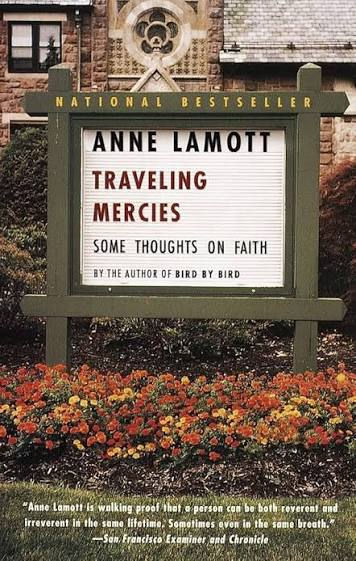
Traveling Mercies (Anne Lamott)
I read this when I was in college and I've recently been revisiting stuff that has felt formative to me over the years - my own personal canon. Most people know Anne Lamott from Bird by Bird (which I am actually reading now!) but this is how I originally came to know her. It's about God and faith and spiritually - but where I came from in Evangelical fundamentalist Texas, Anne Lamott was super edgy and a bit sus because she's a Democrat and uses the F-word and refers to God as 'she' sometimes. So reading her was like finding that cool aunt that mom was always a bit worried when you hung out with. Unpretensious, honest, insightful and very, very funny. I love her dearly.
The prologue itself, where Lamott tells her story of growing up in Libtard northern California, her addictions, the death of her father and finding spirituality is enough of a reason to get this book. It's some of the most beautiful writing I've read anywhere. All the truths she espouses in Bird by Bird are on masterful display here.
Each chapter is an essay about some humble but meaningful insight that she observes in the messy, grimy everyday bits of life - about grief, anger, sobriety, anxiety, parenting, friendship, shame, whatever, with her mostly playing the role of anxious, petty idioton the cusp of receiving some wisdom. My favourite is "Forgiveness" where she describes her absolutely deep-seated hatred for the mom she sees daily at the school drop off who always has make-up on, something I would know absolutely nothing about. " I thought such awful thoughts that I cannot even say them out loud because they would make Jesus want to drink gin straight out of the cat dish."
My favourite line: "It's the worst thing I know, to shout loudly at this fifty-pound being with his huge trusting brown eyes. It's like bitch-slapping E.T."

Eichmann in Jerusalem: A Report on the Banality of Evil (Hannah Arendt)
As heavy as a stone. What is there even to say? It's a masterpiece, its horrifying, haunting, brutal, so clear in its insight, so complex in its analysis. I read it because I'm exploring some topics surrounding the law and justice in response to atrocities - what we expect from it, what it can do for us and what it can't.
It's easy to read this book and see yourself as the righteous person analysing and judging an evil person and, if we're really careless, extrapolate that to apply to the people we think around us are evil. Then, it was Eichmann. Today, it's McKinsery consultants. It is very very important not to do this. It's not what Arendt is doing. She is not trying to take some big moral away from this story about how to spot a genocider when you see one. She is painstakingly reconstructing what happened and interrogating it. Her absolute insistence on the importance of details and particulars directly opposes our tendency to extrapolate to other settings. To read it and tsk tsk at the 'evils' around us is to completely misinterpret her project. We don't get to read this book and feel good about ourselves because we're not Nazis or working for Blackrock (or whatever we think of as 'evil' these days). We have to read it and be horrified at the human psyche's propensity for self-delusion and cowardice and schooled in the distortions that take place when institutions are instrumenatlised for political ends - even if those ends are a demand for justice.
The biggest and most compelling questions this raised for me - what is the law for? What are the courts, a judge, a legal system meant to do? What do we expect it to give us? If what we expect is satisfaction, we will only distort them. Justice and satisfaction, relief, are not the same thing.
Perhaps more astounding than the evil that was committed was Eichmann's, and, as Arendt draws out, that generation of Germans', complete insistence of their innocence, lack of interest in grappling and owning what they did, stubborness to hold on to their view of themselves as good people. This, more than 'those people over there are doing evil things,' is the moral we should take away from the story for ourselves. Be terrified by your own ability to justify yourself to yourself.

To Kill a Mockingbird (Harper Lee)
I remember the table I was sitting at in the Starbucks on Hillcrest and Forest in Dallas when I was in 8th grade when I got to the jury's verdict in this book. I pinpoint it as the moment when I learned about myself that (book spoilers) I have very very strong feelings about injustice. In keeping with Travelling Mercies, this was another book I wanted to revisit because I remember it landing so heavily on me then and, in keeping with The Banality of Evil, I'm exploring ideas of justice, what the law can do for us and the intensity of our own moral feelings.
And let me tell you guys - this one holds up!! I listened to the audiobook narrated by Sissy Spacek and this is absolutely one where the audio adds such a rich dimension to the story. Like, I could feel the heat of the Alabama summer in her narration. I was like this during Atticus' closing argument. And when Miss Maudie's house burn down.
Scout's the narrator, but Jem is all of us.
The scene with the dog with rabies.
Atticus Finch is a zaddy.

The Odyssey (Homer)
That's right! I am not immune to cultural hype! It's fun! I also read Project Hail Mary right before the movie came out and it was a great great time. Reading the books of movies that are about to come out might be my new thing now. And the last time I read the Odyssey was in 9th grade and it is completely wasted on American 9th graders. We have no sense of history. And yes, I read Emily Wilson's translation and it's great and she's a bad ass (of which her many tattoos are obvious proof.) And yes, I saw the movie and have plenty of thoughts on it which I will not share because no one cares about. And yes, I'm reading Circe now - I go full bore into these things. I'm not done yet but so farm I'M OBSESSED!
Wilson's introduction is in and of itself brilliant. I'm embarressed by how much I didn't know about this - that like, Homer wasn't one person. Call me unschooled, it's fine - I never claimed to be an classicist. But I loved learning about how xenia was basically the way the earliest cultures kind of started to prevent themselves from killing each other (interesting beacuse I'm reading Alex Honneth now about Hegel's theories of early ethical development, more on that later!)
Goddess Athena, give me metis! I want it so bad.
The first chapter is called The Boy and the Goddess and that's exactly what I think every time i see a picture of Tom Holland and Zendaya standing next to each other.

Representations of the Intellectual (Edward W. Said)
It's hard to pick from this list of masterpieces - but this might be the one I would recommend at the top for everyone to read right now. I picked it up from the Blackwell's table cringing at myself because to buy a book about what it means to be an intellectual means you have to kind of admit to yourself that you want to be an intellectual and that is just so embarrassing. But like, who wouldn't want to be Albert Hirschman or, I dunno, Rory Stewart? You could make a whole Pinterest board out of that vibe.
These Reith Lectures are anything but vibes though. And the lifestyle of thought and articulation that Said articulates is something I think we should all aspire to, even while he describes how difficult and unpleasant and almost impossible it can be. Reading it felt like having all of my embarrassments, insecurities, ambitions and aspirations described to me.
Major Thesis: "The intellectual is an individual endowed with a faculty for representing, embodying, articulating a message, a view, an attitude, a philosophy or opinion to, as well as for, a public. And this role has an edge to it, and cannot be played without a sense of being someone whose place it is publicly to raise embarrassing questions, to confront orthodoxy and dogma (rather than produce them), to be someone who cannot easily be co-opted by governments or corporations, and whose raison d'etre is to represent all those people and issue that are routinely forgotten or swept under the rug.... Least of all should an intellectual be there to make his/her audiences feel good: the whole point is to be embarrassing, contrary, even unpleasant." My Enneagram 4 heart is all aflutter. (Also, important to acknowledge that 'orthodoxy and dogma' exist just as much on the Left as they do on the Right.)
I'm probably biased though because a big part of these lectures is in distinguishing between intellectuals and consultants, the latter of which whose 'main role is to provide authority with their labor while gaining great profit,' which panders to my need to be told its ok that I've chosen a terrible career path that makes no money.
Corrosive to intellectualism is specialisation - of which academia is most guilty. Intellectualism is driven by curiosity and Said uses the word 'amateur' affectionally to describe someone who follows their curiosity rather than scales up their competence.
Truly, there is so much in these lectures, they are so rich, so dense, so beautiful. Everyone read.

The Writing Life (Annie Dillard)
As with the label 'intellectual,' I'm so cringed out admitting to myself that I'm trying to be a 'writer' via buying this book. But also, I'm an academic and academics write a lot and yet somehow tend not to see themselves as writers even though our entire work and career depends on it. Back in my RA days, I read Becoming an Academic Writer where Goodson says academics have this toxic trait of not thinking of themselves as writers so they... don't write. But they are! So better to admit it to ourselves and get writing than be all embarrassed about it.
I've not read anything else by Dillard and I can't remember what made me pick this one up. She's a gorgeous writer and I read each chapter in this twice because it's so lush. Here writing is sparse and precise, thus my notes will be.
Alone in a cabin in the woods (like Circe!) like Dillard describes is my fantasy alternate life.
Thoreau: "Pursue, keep up with, circle round and round your life... Know your own bone: gnaw at it, bury it, unearth it, and gnaw at it still."
"Complex stories, essays and poems have this problem - the prohibitive structural defect that writer wishes he had never noticed. He writes it in spite of that. He finds ways to minimize the difficult; he strengthens other virtues; he cantilevers the whole narrative out into thin air, and it holds."

Hamlet (William Shakespeare)
Look, call me a Philistine, but I didn't know anything about Hamlet. I read this because Taylor Swift wrote Fate of Ophelia and I didn't know anything about Ophelia and I was annoyed because Taylor Swift knew more than me.
I'm not proud to say it, but I have attempted Shakespeare several times and have not been able to get into him. I'm a simple Texas girl who likes plainspeak and isn't enlightened enough to enjoy listening to poetry I don't understand. But I've been trying to elevate myself and getting more into poetry and stuff because Anne and Annie told me to. I began trying to immerse myself in Hamlet by watching the Laurence Olivier version and tracked with maybe 40% of it. Then I watched the Kenneth Brannaugh scene where he screams at Kate Winslet to get to a nunnery and I felt very awkward. Perhaps I'm a visual processor, but I had to read it - to slowly metabolise phrases.
And you know what, yes! Underneath all the language is a very compelling story!
From what I can tell in my minimal wading into the centuries of content on this, everyone thinks this is about Hamlet's lack of decisiveness. To me, this was about the absolute gaslighting of a younger generation - both Hamlet and Ophelia - by an older generation that is doing disgusting terrible things but is trying to convince the youngers that everything's alright and 'What are you so upset about?' it drives the youngers crazy and then Hamlet does it to Ophelia and she literally goes insane. But maybe I'm projecting?
Some major parallels between Hamlet and Orestes from The Odyssey and the whole Agammemnon thing! Apparently the pressure on sons to avenge their murdered fathers has been a major preoccupation for men throughout history?
I don't know much about anything, but it seems like, at the time Shakespeare wrote Hamlet, there wasn't too much coming out that dove into the inner psyche of a character at this level and explored its interiority. He probes the emotional discrepancy that can exist between the role an individual is expected to perform and what a deeper reality demands of him to remain internally coherent. Maybe that's why people say this was the beginning of the modern mind?
(Unlike Circe and The Odyssey, I have not read Hamnet yet because I read somewhere that it's punishingly sad, especially for a mom with a young son, so I'm reticent. But I will at some point.)

Matilda (Roald Dahl and Tim Minchin)
Not a book, but I need to feature it because it has been such a big part of our summer. One day, I had to take my kids into London to get new passports. Decided to make a day of it and take them to see a show. Now, I am usually staunchly against musical renditions of stories that were initially other art forms. Like, who ever asked for Legally Blonde: The Musical? No one. But Matilda: The Musical has had some staying power over the years and Tim Minchin is a genius obviously so went for it. And...... omigod. It was fantastic.
So of course I immediately had to watch the Netflix movie which came out in 2022 and which I ignored because the original 1996 version was traumatising. But when I went to the musical, I remembered I'd seen an infectious dance scene floating around Instagram when it came out. So watched it with my kids and forced my dad (who was visiting from Texas at the time) and my husband to watch it and suffice it to say, both of these men were sob-crying by the end.
Americans can't understand Matilda. I did not appreciate before how this is so deeply a British story. Americans can't fathom school and adults being so mean to kids so we have no category for Miss Trunchbull. So appreciated this so much more after living in this country for 10 years.
Every single song is brilliant. So many brilliant lyrics, but Naughty and Quiet are my favourites.
This, on repeat.


