A brief tour of a US meatpacking plant (with playlist 🚗)
Updated: Jun 26, 2025

I've spent an inordinate amount of time the last six months looking at meatpacking plants from the sky and I'm here to share that a God's eye view of this industry is...a bit addictive?
Backstory is that I'm building this dataset of how plants' spatial footprint has changed over the past 30 years by hand-drawing polygons over them in Google Earth Engine. The goal is to identify major CAPEX events - moments when the company invested lots of new money in expanding the plant - so that we can measure the length and degree of their financial lock-in.
There are only ~45 big industrial plants slaughtering cattle in the US so outlining them was enough to make me question my life choices but not so much to make me question the meaning of life. (Yes, I explored many different ways to use a change detection algo to automate this process but meatpacking sites are so complex that it makes this quite difficult and the time it would take to build an algo is the same as just doing it by hand.)
During this time, I've become intimately familiar with the layout of US meatpacking plants. Satellite imagery is particularly helpful for getting some insight into an industry that is famously un-transparent and difficult to access. Transparent and accurate knowledge about every aspect of where our food comes from is essential for making sure we're all speaking from the same starting point.
So I thought I'd take you on a little tour of a US meatpacking plant from the sky - the Tyson plant outside Amarillo, TX, to be specific. I have a special attachment to this plant because (1) it's in Texas, my home state, (2) it has all the components of a quintessential plant, (3) it was one of the first I studied and where I really familiarized myself with plants-from-the-sky and (4) I drove around the perimeter while roadtripping through cattle country last summer so I have a few non-satellite related tidbits to share.
Now, WARNING! These images aren't pretty. What happens inside a slaughterhouse isn't pretty. When I started studying these quite closely, even from the sky I found it...upsetting. I've also presented this work a few times now to different audiences and in one presentation, one poor guy literally cupped his hand over his mouth and gasped. It is undeniably a gruesome subject.
So to aid us on our journey, I've crafted a playlist to accompany us. The theme is "Existential Roadtrip" - capturing the feeling of the open American road, driving from Oklahoma City to the Panhandle with a mix of weighty anticipation paired with anthemic dread. (Side note - remember that time Jason Aldean casually referenced driving with an open container? 2010 was a wild time.)
As a little treat at the end, I've listed everything I listened to during several months worth of outlining plants.
"Little babies, let's go!"
Alrighty, so let's meet our plant. Here she is. Click through to Google Maps and have a little snoop around.
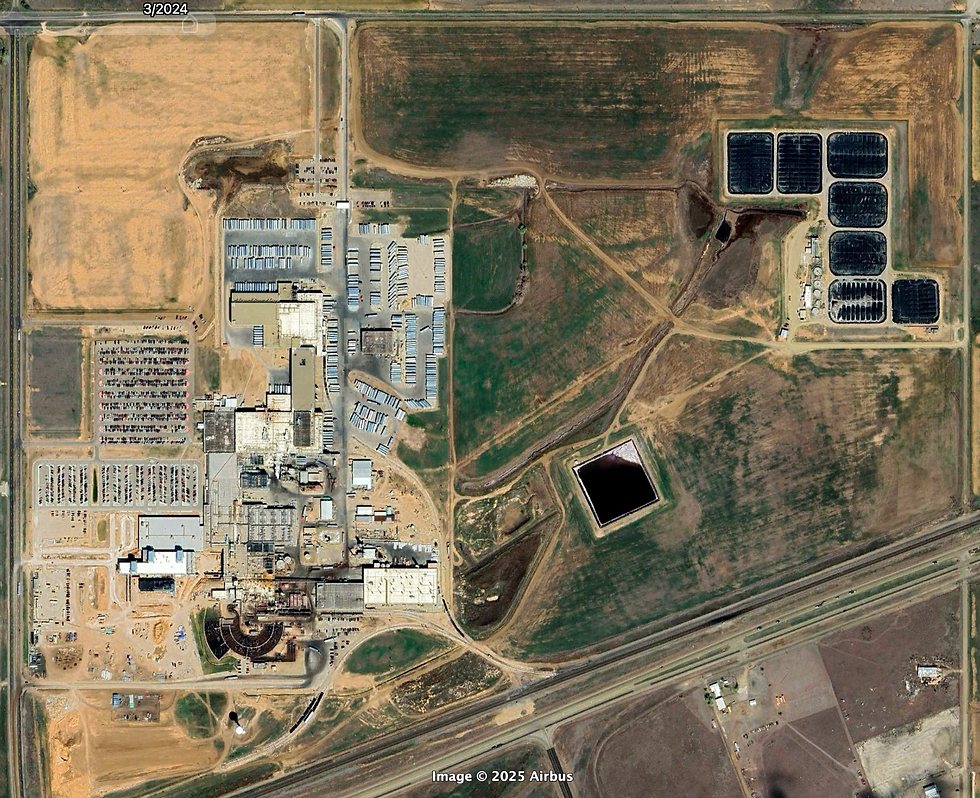
So there are four basic components to your standard industrial US meatpacking plant: (1) your buildings, (2) your employee parking, (3) your truck parking and (4) your wastewater ponds (for a majority. Some use other methods.) Scattered among these four main components are different bits and bobs - train tracks, land for waste spreading, unidentifiable rubbish, etc. We'll get into these too.
The buildings
Perhaps what immediately stuck out to you was the visibility of the stockyards with herds of cattle waiting patiently for their ultimate demise.

You really get a sense of the motion here. Trucks, some coming from several hundred miles away, backing up, unloading, pulling away with more on their way. This particular plant has the capacity to slaughter up to 6,000 cattle a day (roughly one every 5-12 seconds). A typical livestock hauling truck carries ~40 cattle. This means a truck is being unloaded approximately every 5 minutes during working hours. Our Tyson plant has 3 chutes which helps keep things flowing smoothly.
This half-moon pen design and curly chutes are particularly interesting. If you follow debates in humane animal slaughter or are a big Claire Danes fan, you might recognize this as Temple Grandin's design. The curls are intended to reduce animal stress. I've now become a bit of a connoisseur of cattle holding pens outside meatpacking plants. Here are a few other commonly employed specimens:
Tyson, WA | Talk about 'from feedlot to fork' - efficient!
Now, because I'm a huge snoop, I looked up the public records for the Tyson plant from Potter County (you, as well, can snoop here!) And seriously, there are some fascinating nuggets you can find in public records. Like, Tyson gave a $17,000 loan to the Keshmiry's for a house - likely a nice relocation package. Also, in December 2024, an Amarillo court ordered Tyson to pay $9 million to Thu Kaw, an employee, for "pain, suffering, mental anguish" and "disfigurement." Cool, cool, cool cool cool cool.
Also found in the public records (in a notice on the remediation of pollutants, no less) is this gorgeous layout of the different parts of the plant. It is from 1996 so perhaps (probably) some stuff has shifted around since then. But it is quite helpful for getting a sense of what is contained inside the building and mapping that to what it looks like from sky.

So starting from the stockyards, once we enter the building, you've got the kill floor on which I will not say much at this particular moment. But there is plenty you can find on it if you want to understand more about that process. (I would not recommend entering this as a search on YouTube, though.)
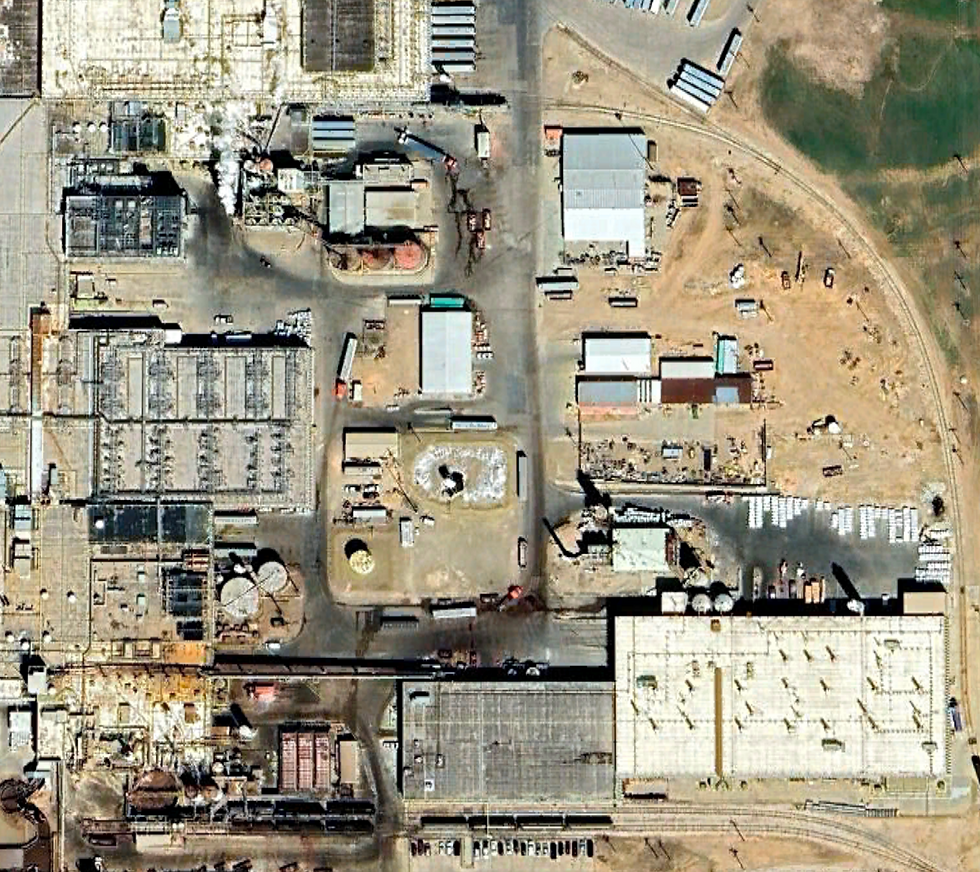
All of the chicanery along the interior of the site - the pipes, silos, holding containers, etc. - are for handling the by-product. There are three main types of by-product - (1) offal (intestines, spleen, lungs, etc.), blood and bones, (2) fat and (3) skin.
The first are all rendered down to separate out the solid proteins and turn it into meat and bone meal for pet food, animal feed and fertilizer. The second group - fat - is rendered into beef tallow which is used in biodiesel, soaps and detergents, etc. All of this is done either in the 'inedible rendering' portion along the bottom or towards the northern 'render' part. For the third group - skins are salted before tanning for leather. The white patch in the centre is where salt brine is mixed and held for curing hides.
And - special to this plant - Tyson tans its own hides which is not so common in the industry. I had to check the EPA's Toxic Release Inventory to make sure they're still tanning hides. In 2023, they released 7,500 pounds of chromium (not the hexavalent kind) - the main chemical in leather tanning. So yes, we have a tannery on this site.
So, I went and did a little drive around the perimeter of the site and let me tell you, it stinks so bad. Like, even from very far away. When I was speaking with a local professor and asked him about the smell, he said it was the tannery. I just thought it was all the decomposing wastewater (see below). Maybe/probably it was both. But Tyson has this polite little sign up saying they're renewing their air quality permit - so no problems here!

The railway and tankcars running along the bottom are likely bringing in the chemicals and other materials use in these by-product processes and then shipping out the resulting meat and bone meal and/or rendered tallow. The pipe connecting the kill floor to the buildings on the right may sending over tallow, grease, condensation or other byproduct - or may be sending chemicals for the rendering/salting/cleaning process over.
While all this stuff is called 'by-product', this is a bit of a misnomer because this is very much just product. In May 2025, by-product accounted for about 6% of meatpackers' revenue p/ pound of retail beef sold. Not a crazy amount - but helpful for understanding the degree to which meatpackers are milking (forgive me) cattle for every penny they're worth.

Moving right along, to the north, we have fewer pipes and things look a bit more well-behaved. This is LOTS of cooler storage and the secondary processing facility where the carcasses (the big half-cows of meat) are butchered into further retail-ready cuts and put into the infamous 'boxed beef' containers (that technology that so revolutionized the meatpacking industry in the 1970s.) It is also what is described in this memorable piece in The Atlantic.
Employee parking
So there's not an enormous amount to say about employee parking except that it's cute to see where people park when the lot is full.

Also, looking at these parking lots from the sky, I can feel how hot it is there. Like I can feel the tar melting on the pavement. I can see the employees covering their leather car seat with a towel before getting in at the end of their shift to avoid scalding. Nothing is hot like the heat of an exposed parking lot in a Texas summer.
Truck parking
So then we've got truck parking!

Now I have to say that when I first started looking at slaughterhouses-from-the-sky, I didn't give that much thought to the trucks. I mean, they're not really the most charismatic feature of this site. That was, until I found the Google Reviews.


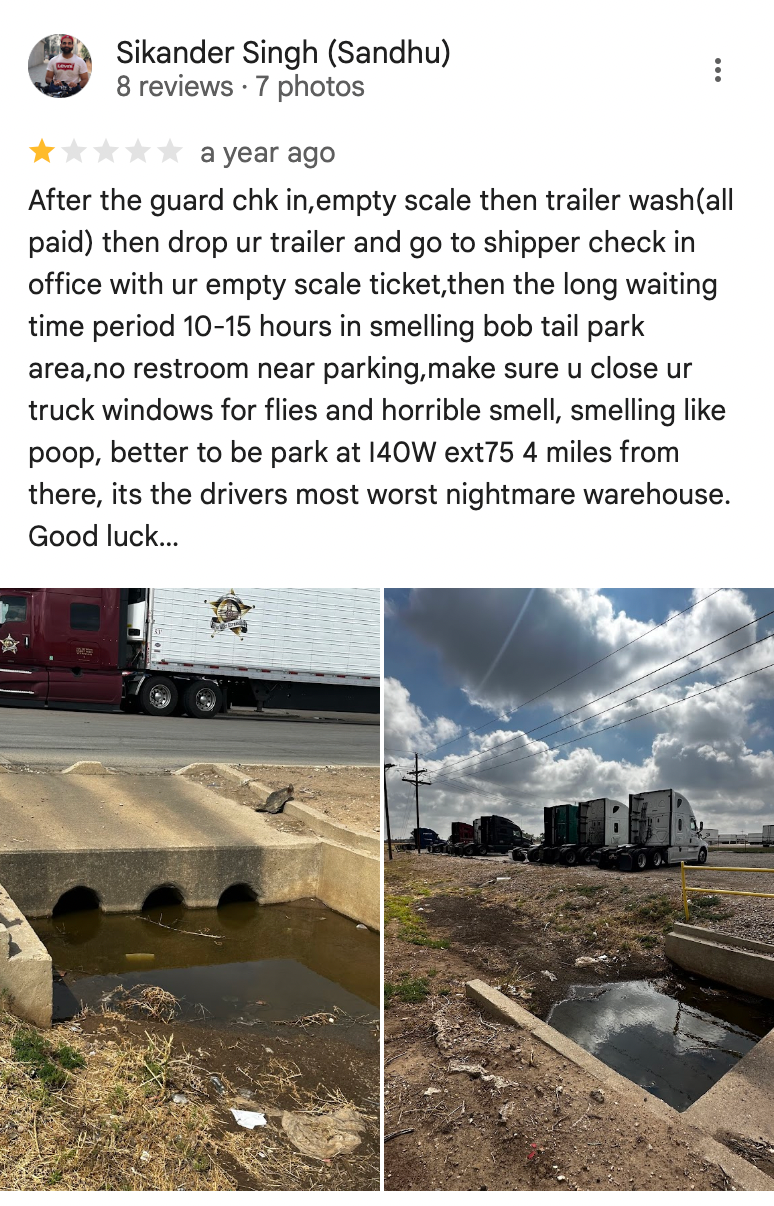


OK - can we get an anthropologist in here stat to do an ethnography on the experience of truck drivers picking up loads from slaughterhouses? I don't know a single person in the world who leaves reviews on Google - but there is a vibrant community of truck drivers on there.
I had to straight up ask ChatGPT what was going on in these reviews. It explained to me that plants like this will contract with a trucking company to pick up its beef and schedule times for drives to come pickup their shipment. But truck drivers commonly report being left waiting several days after their scheduled time for their shipment. This is very bad for the drivers because they are paid for miles logged and sitting still for several days causes major disruptions for them. Also, you know there is all kinds of hellish paperwork involved and tracking numbers and truck weighing and wash outs and all that stuff.
What looks like nice tidy rows of trucks actually apparently contains utter chaos. I've read reviews of people who couldn't find their trucks when they left and came back or places where there just isn't enough parking and trucks end up stretched out along the highways and side roads. While not totally on display here because the site it so big, you can definitely see them scattered around other plants.
I'm sure a whole PhD thesis could be written on the logistics of meatpacking plants and why it doesn't seem that the loading docks can keep pace with the kill floor (maybe that's why so much cold storage?) That is not my PhD, but if you write it, I will read it.
Wastewater Ponds (and other waste stuff)
We've finally made our way to the ponds.

Really getting into these ponds will require a whole different post. Suffice it to say that cattle slaughter is messy and creates lots of 'effluent' - organic matter that isn't beef or byproduct. This effluent gets washed away with water at the end of the slaughter shift and that water gets sent to these ponds where there are various methods for dealing with all of that organic matter. Some of it is anaerobically digested, some of it is recycled, etc. In many cases, a company will put giant tarps on top to contain odours (which are considerable), capture methane, prevent rain spillover, control algae, etc. These tarps are the undulating ripples visible in the image above.
To answer your question, yes - meatpacking plants can be major water polluters when wastewater gets into public water ways or seeps into the groundwater. Now, it's impossible to tell from these images if Tyson is managing its wastewater well and, if any of it is escaping, if it's causing damage. It does appear that perhaps some water is escaping just underneath the left part of the pond.
When I drove around the perimeter, in addition to the completely noxious smell, I did see some pipes with water leaking out behind the back of the fence into a giant puddle - although I can't be certain where it came from or if it was contaminated.

But partially what drew me to drive around the site in the first place was that if you zoom out quite a bit from the picture, you see something very interest.

There's a little trail that leads from the ponds up to what is called a 'playa', a shallow seasonal lake that fills with rainwater during certain times of the year. Why there is a trail leading from some wastewater ponds to this playa, I don't know for certain. But what I do know from public land records is that Tyson owns all of the land surrounding this playa. It also owns all of this land as well!

The big green lake - Lake McGee - is owned by Tyson. I drove along the dirt road leading up to it and saw quite a few signs saying "Don't drink the water" - noted!
McGee Lake on a cloudless day Don't drink this water - seriously.
It is also impossible to know for sure how Tyson is using this pond but I'm gonna venture a guess that when we say 'wastewater pond,' we can, for certain plants, think very big.
All of the land it owns around the plant is where they are pivot-irrigating the wastewater onto fields. They are most likely growing sorghum for animal feed - the circle of life.
Zooming in once more, we see another type of pond and a funny looking, brown-ish textured patch that looks different than the rest of the surrounding land.

The pond is probably using for digesting organic compounds - the foam in the top corner may be the result of the gases it is producing.
As for the brown textured area, when I showed this picture to a cattle rancher, he saw this bit and quickly said, 'That's where they're spreading the paunch." Paunch is what is found in the contents of the cattle's stomach during the slaughter process and is commonly dumped somewhere on a site for management and decomposition - a process that produces methane. (Fascinatingly, it is quite easy to identify these areas using a false colour composite of a satellite image with NIR and SWIR bands.)
If you look carefully, you can see pipes funneling water all over the site, including to this big puddle/pit on the left.

This pit could maybe be for wastewater from truck cleaning? Or maybe more run-off? I honestly have no idea. And the white pile - that has been bothering me for months because I honestly can't figure it out. It could be bones - like spinal cords and skulls that can't be rendered because of that whole mad cow situation - but someone should confirm that for me.
So all in all, a bit of a mess I'd say!
We have come now to the end.
There you have it - a jaunty run-through of a meatpacking plant!
There's not really any question that this industry is quite a substantial polluter along with all of the other quite brutal things that go on inside, both to cattle and the people who work there. For those of us who work in food, it is easy to look at this and see how polluting it is in comparison to grain processing or veg harvesting and see this as indisputable proof that the industry is evil. However, when looking at it from a finance lens, this is a polluting industry just like any number of other polluting industries in the economy. And if you've already signed on for having a bit of pollution in your portfolio, what makes this any different?
As I said above, when it first really started to sink in for me what I was looking at, I found it quite upsetting. I had a big emotional reaction even - and felt like a huge ninny afterwards. I've kept looking at them though and that strong emotional reaction has been blunted. But I found it notable that when I have talked to people who work adjacent to the industry, they seem to see that emotional reaction as evidence of a un-scientific mind or overly-emotional sensibility rather than an indication that, in our guts, we know that what's happening here isn't really great at any level.
So this tour isn't meant as finger-wagging at the industry or to generate righteous rage. It is meant to increase transparency, lay out plainly the process and let you decide how you - dare I say - feel in response to it. That is actually one of the beauties of satellite imagery. There isn't a photographer or anyone trying to manipulate you with a certain framing. It is just showing what is - from the sky. We then decide what we think about it and how we respond to it.
Everything I listened to/watched while outlining 30 years of satellite footage for 45 meatpacking plants:
The assignment here was to find stuff that would 👏🏼 keep 👏🏼 it 👏🏼 light!
Be Ready When the Luck Happens, Ina Garten (Audiobook)
The latest season of Normal Gossip
The Freewheelin' Bob Dylan (mostly Girl from the North Country on repeat)
Challengers (for like the fourth time)
The first 3 episodes of Outlander (then I went back to Hacks)
What We Do in the Shadows (not totally SFW)
Endless amounts of Pop Culture Happy Hour (and hard disagree with their take on the songs from the second act of Wicked)
Like I said - 👏🏼 keep 👏🏼 it 👏🏼 light!